1
0

common:latest-news

[ 1 ]

On Thursday 24 September at 19h, Wanling Chang, Celeste Tellarini & Gianni Villa will present PAS MAL, a collection of 200 photos of Brussels by Celeste Tellarini, in our exhibition space et al., ... followed by a "Brussels Bingo"!

The event will continue as a three-day (25/09_27/09) exhibition in our exhibition space.
Neither Garden Nor House-0

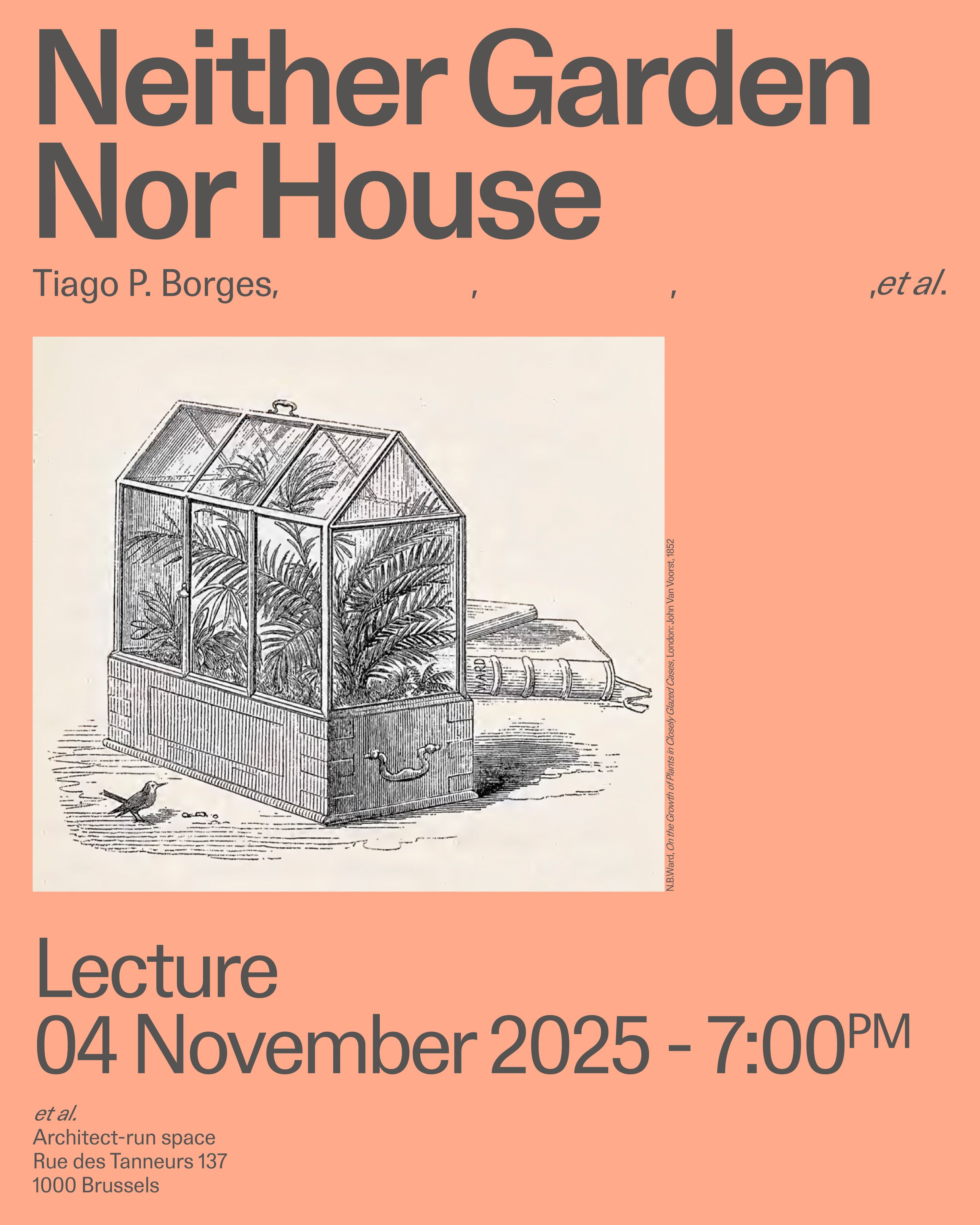
Neither Garden Nor House

et al., Brussels

In the framework of Residency #004 - The Moving Spirit, we were delighted to welcome architect Tiago P. Borges for a lecture on greenhouses as domestic space!

By looking at key projects it is possible to frame the greenhouse as an architectural device with distinct characteristics and agency, and it is possible to trace its evolution from botanical utility to domestic significance.

Themes linked to greenhouse spaces, such as relations between interior and exterior, functional indeterminacy, thermal gradients, passive energy strategies and seasonal patterns, are explored for their broader architectural implications.

By considering the greenhouse as a collection of spaces with distinct climatic identities, it is possible to challenge traditional architectural typologies and argue for a fundamental revision — a climate-based approach to typology.

Tiago P. Borges recently earned his PhD degree in architectural theory and history at EPFL with a work that examines the interplay between greenhouses and domestic spaces from a typological and historical framework. He is currently a postdoctoral researcher and leads the Greenhouse Studies design studio at Laboratory EAST, EPFL.

On Tuesday 04 of November, Tiago presented us his research at et al.

Lecture
common:date04.11.2025
common:more-info

In the framework of 'Residency #004 - The Moving Spirit', we were delighted to welcome Tiago P. Borges for a lecture on the greenhouse as domestic space!

In its modern conceptions, the greenhouse is a relatively recent artefact in the history of Western architecture, whose emergence and diffusion are inextricably linked to its colonial origins. Initially designed as controlled environments for conserving "exotic" plant species, greenhouses evolved into social settings and, by the early 19th century, had become an integral part of the ideal bourgeois villa. This marked the beginning of a far-reaching and long-lasting impact still present today.

By looking at key projects it is possible to frame the greenhouse as an architectural device with distinct characteristics and agency, and it is possible to trace its evolution from botanical utility to domestic significance. Themes linked to greenhouse spaces, such as relations between interior and exterior, functional indeterminacy, thermal gradients, passive energy strategies and seasonal patterns, are explored for their broader architectural implications. By considering the greenhouse as a collection of spaces with distinct climatic identities, it is possible to challenge traditional architectural typologies and argue for a fundamental revision — a climate-based approach to typology.

language