common:latest-news
The exhibition Dirty Materials: Undoing, Dismantling, Undesigning is opening on Thursday 22nd of January at 7:00PM. It will be on show in our exhibition space et al. until Saturday 7th of February.
Visits possible every Friday (10:00-17:00) and Saturday afternoon (14:00-18:00) or on request!


Negotiating Ungers
In 1972, Oswald Mathias Ungers and his students at Cornell University developed the Self-Help Housing System, alongside his research on utopian communities in the United States. These projects highlight architecture as a collective and process-driven practice.
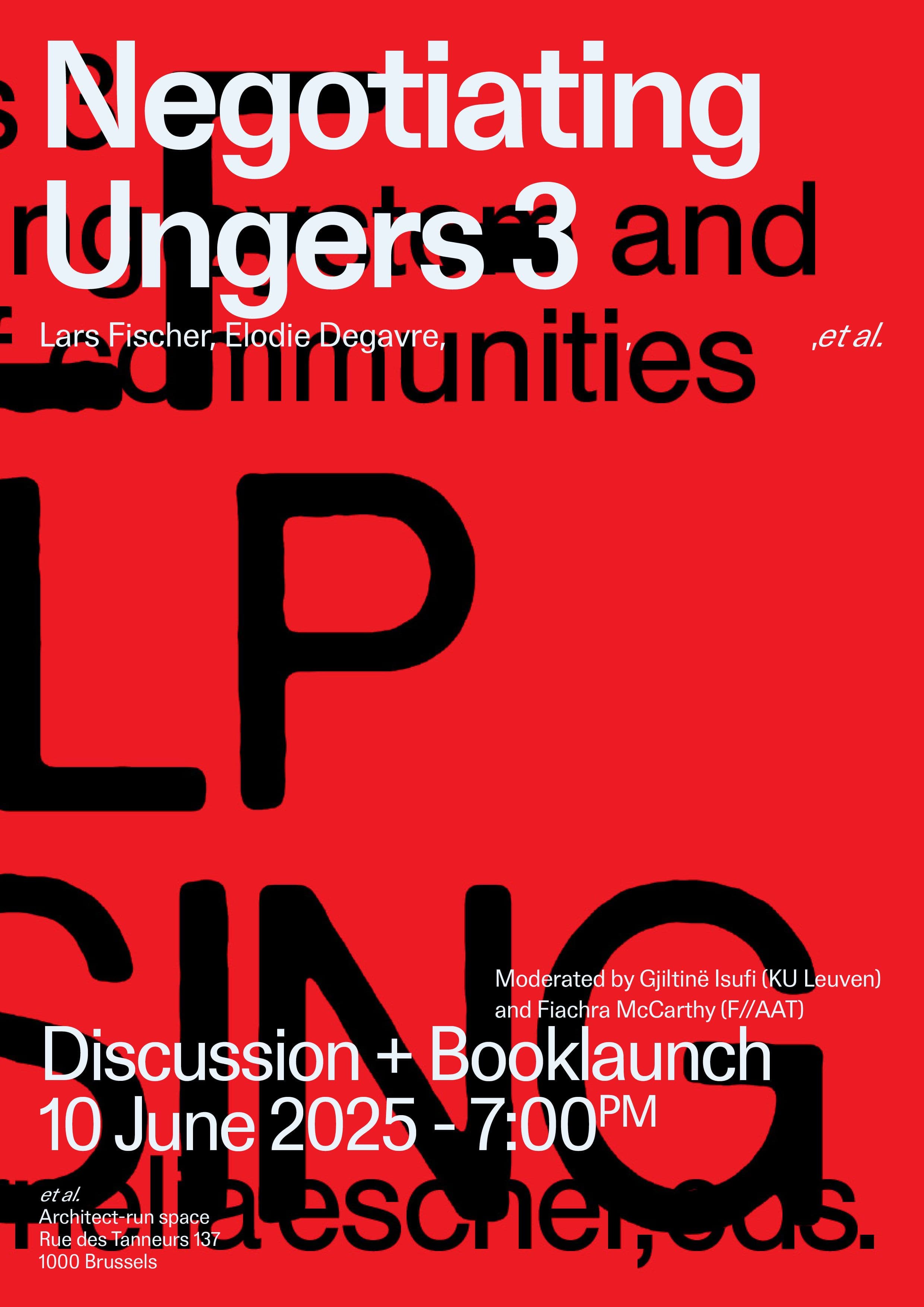
On 10 June, editor Lars Fischer presented the publication Negotiating Ungers 3, followed by a discussion with architect and filmmaker Elodie Degavre at et al. The conversation explored Ungers’ work in relation to Belgian experiments of the same period and the contemporary relevance of these architectural imaginaries.
The event was moderated by two participants of the Negotiating Ungers workshops Gjiltinë Isufi (KU Leuven) and Fiachra McCarthy (F//AAT).
| common:date | 10.06.2025 |
In 1972, German architect Oswald Mathias Ungers and his students at Cornell University in Ithaca, NY, developed a prototype for a Self-Help Housing System (S-HHS). Shortly before, Ungers and his wife Liselotte had begun a research project on utopian communities in the United States; the study was published in 1972 under the title “Communes in the New World 1740-1972”. Taken together, both projects point to the processual character and the broad agencies involved in architectural production.
On Tuesday 10 June we welcomed the editor Lars Fischer of common room for an introduction of the publication “Negotiating Ungers 3. The Self-Help Housing System and the Construction of Communities”. This was followed by a discussion with respondent Elodie Degavre, architect, educator and director of the film “La Vie en Kit” (Life, Assembled). This conversation was an opportunity to examine the originality of Ungers’ work in relation to Belgian experiments from the same historical period, which are explored in the film, as well as to reflect on the contemporary imaginaries that these experimental proposals invite us to reconsider. The event was moderated by two participants of the Negotiating Ungers workshops Gjiltinë Isufi (KU Leuven) and Fiachra McCarthy (F//AAT).