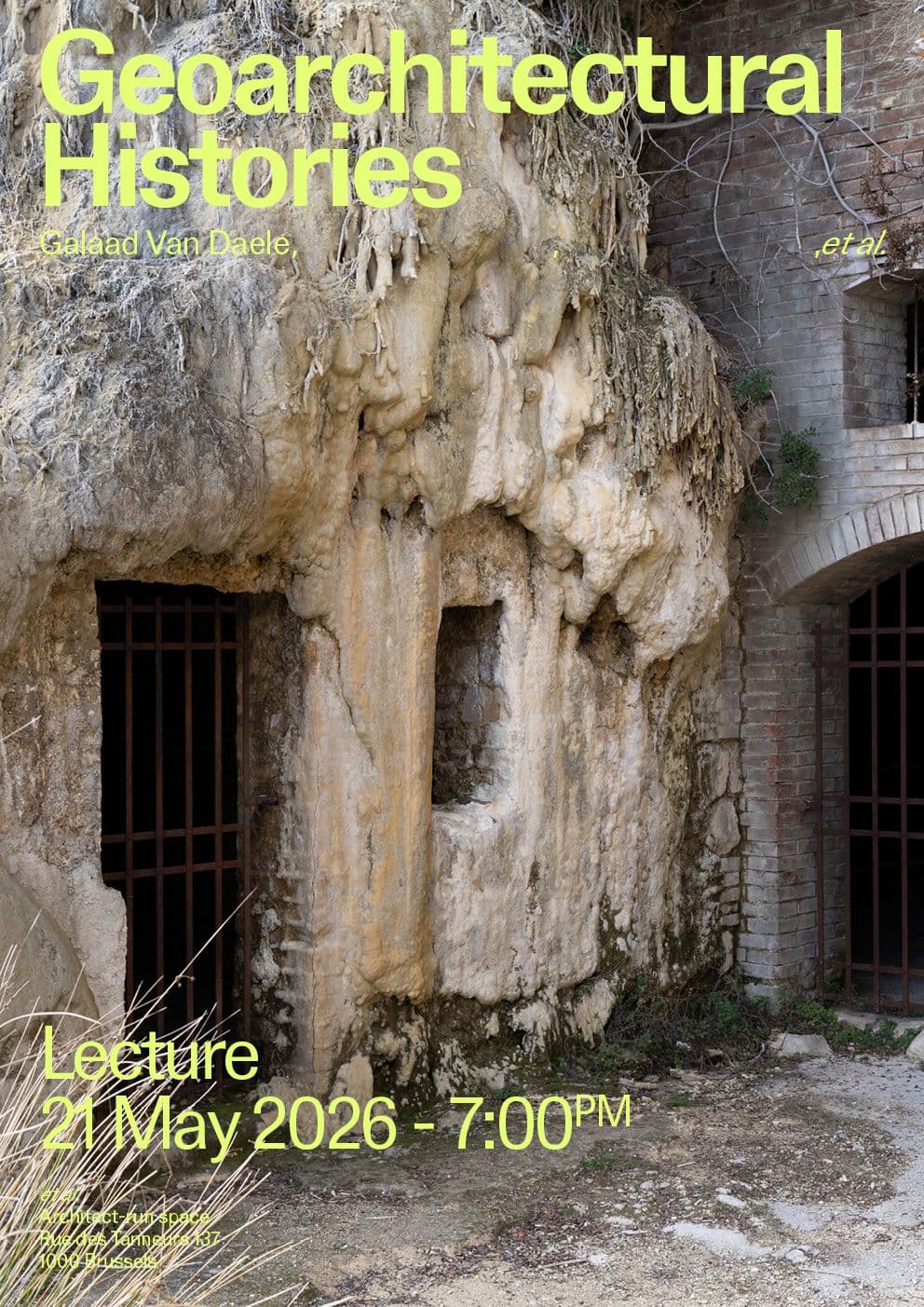
On Thursday 21 May, we were pleased to welcome Galaad Van Daele, architect, editor and researcher, to our exhibition space, et al., for a presentation of his research project 'Geoarchitectural Histories'.
Every building begins underground, as constructing with steel, glass, concrete, aluminium or even plastic always means extracting and transforming iron ore, sand, limestone, bauxite or petroleum. Yet this profound intertwining of the built environment with the Earth's crust is largely neglected, both in contemporary practice of design and construction, and in the way architecture history is written.
Galaad Van Daele discussed his recently completed research project 'Geoarchitectural Histories: The Rocks of the Grotta Grande', which staged a disciplinary encounter between architecture history, the environmental humanities and the Earth sciences. At its centre is a grotto: an artificial cave built in late 16th-century Florence, whose rough, untransformed rocks carry millions of years of environmental history. By paying close attention to the deep time of this materiality, the project asked what it means to account for the geological origins of buildings, and what this can shift in our understanding of architecture.
Starting from the Grotta Grande as the manifestation of a fundamental geological anchorage at work in architecture, the talk broadened the inquiry to what a geocentric perspective on architecture can mean, both for historians re-reading the past, and for practitioners shaping what is to come.