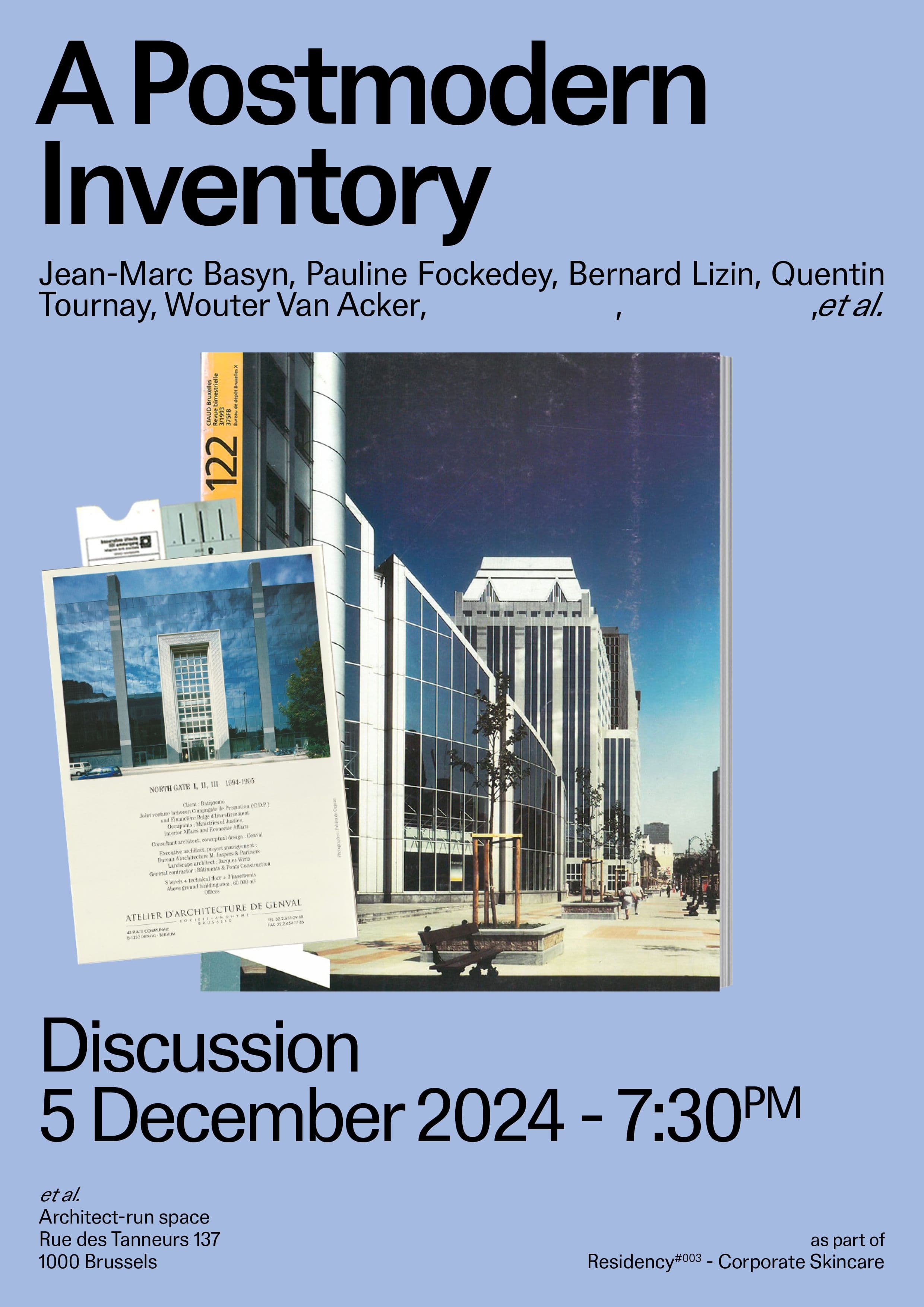
Postmodernism, with its eclectic ornamentation and reinterpreted historical references, has left a deep mark on Brussels’ urban landscape. This movement emerged as a reaction to modernism and the numerous demolitions that reshaped the city, while coinciding with the introduction of the first thermal regulations. However, as many buildings from this period have been transformed, demolished, or reimagined through new BMA competitions, a crucial question arises: do these buildings deserve to be recognized as heritage worth preserving?
This lecture, organized at et al. on December 5 at 7:30 PM as part of Residency #003 Corporate Skincare, explored the complex connections between modernism and postmodernism, the criteria for heritage selection and inventory, and perspectives on an architectural era that shaped the Belgian capital between 1980 and 2000.
In the introduction, Bernard Lizin from Atelier de Genval presented a selection of emblematic projects, illustrating the diversity of postmodern production in Brussels. This was followed by a lively discussion moderated by Pauline Fockedey (Nord Architecture), bringing together Jean-Marc Basyn (Urban Brussels), Wouter Van Acker (ULB researcher on postmodernism), and Quentin Tournay (ULB student). Together, they reflected on the place of these buildings in the city, their aesthetics, and their potential recognition as part of the heritage sphere.
An invitation to reflect on our relationship with postmodernism and the legacy it has left on Brussels’ urban landscape.